

Bambu Lab P2S Combo 3D Printer Offers Advanced Features with Practical Considerations

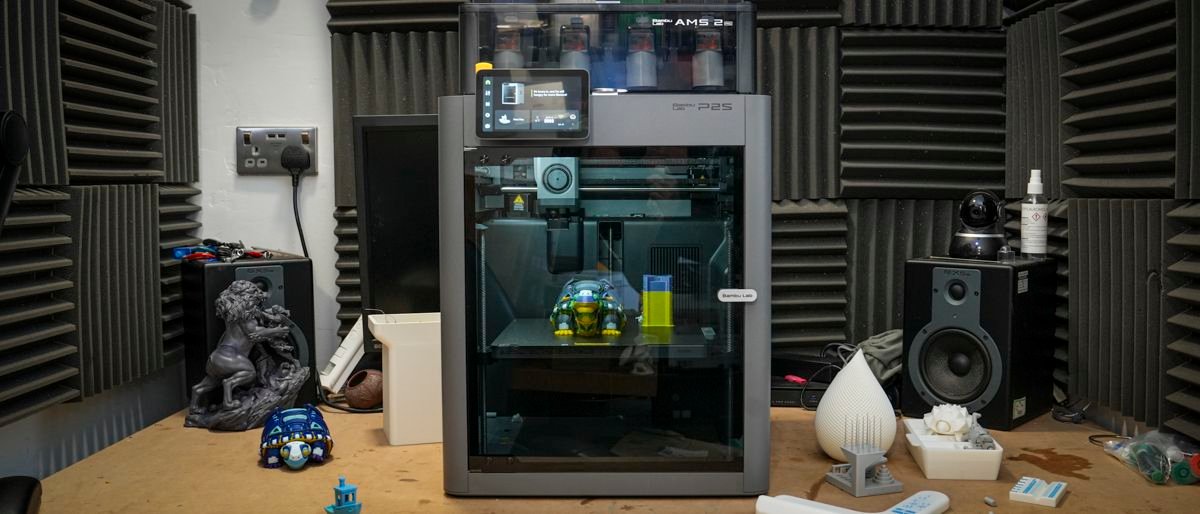
The Bambu Lab P2S Combo 3D printer builds on its predecessor’s success by integrating advanced features aimed at enhancing user experience and print quality. Key upgrades include a 5-inch colour touchscreen, tool-free nozzle swapping, a 1080p camera with AI-powered failure detection, and an adaptive airflow system designed to optimise printing conditions for a variety of filaments.
At the core of the P2S is an adaptive airflow system that manages the build chamber environment by retaining heat and filtering air through a carbon filter. This system supports chamber temperatures up to 50°C, facilitating the use of engineering-grade filaments prone to warping. However, user reports on fumes vary: while some find the enclosure effective enough to keep the door closed during printing, others note intense fumes escaping around door seals when printing high-temperature materials like ASA. This highlights the importance of adequate ventilation and careful printer placement.
The printer supports a build volume of 256 x 256 x 256 mm and features automatic bed leveling. Its hardened steel nozzles are available in multiple sizes and can be swapped quickly without tools, simplifying maintenance. The P2S’s toolhead can reach speeds up to 600 mm/s with an acceleration of 20,000 mm/s², enabling fast and precise printing.
The Combo package includes Bambu Lab’s Automatic Material System (AMS) 2 Pro, which holds four filament spools and allows seamless multicolour printing. The AMS also dries filament to prevent moisture-related issues, a valuable feature in humid environments. Connectivity options include USB, Wi-Fi, and Bluetooth, though Ethernet is not supported.
In extended testing, the P2S produced consistently high-quality prints with few failures. Its AI failure detection monitors prints for common issues such as nozzle clogs or filament grinding, pausing operations to minimise waste. Despite this, the system’s real-world effectiveness remains to be fully validated. The printer’s high-speed movements can cause significant vibration, requiring a very stable surface to avoid print errors.
A notable drawback is the filament waste generated during multicolour printing, as purge material is expelled through a rear chute. Users are advised to manage this waste with collection trays or similar solutions. Additionally, while the airflow system helps maintain temperature and filter fumes, the P2S does not feature an actively heated chamber, a capability found in some higher-end models.
Overall, the Bambu Lab P2S Combo is a refined and feature-rich 3D printer well suited for beginners to intermediate users who prioritise convenience and multicolour capabilities. Prospective buyers should consider ventilation, stable placement, and waste management when integrating the P2S into their workspace.