

Senate Set to Decide on Kevin Warsh Fed Nomination as Powell’s Future Remains Uncertain

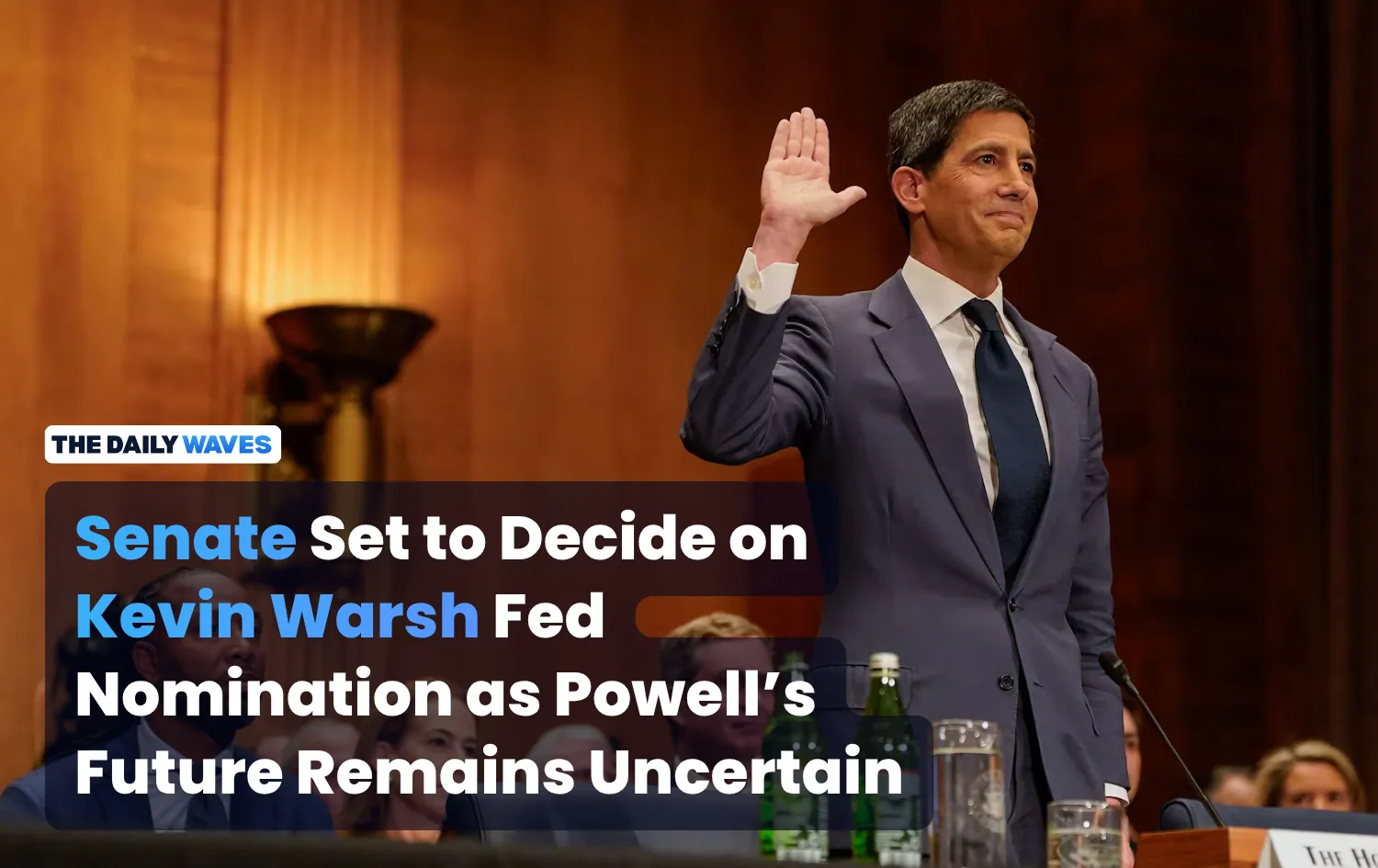
A key decision in Washington could reshape leadership at the world’s most influential central bank. Lawmakers are preparing to vote on Kevin Warsh’s nomination, yet uncertainty surrounding current chair Jerome Powell continues to cloud the outlook.
Momentum behind Warsh gained traction after Jeanine Pirro moved to drop a criminal probe tied to renovation costs at the Federal Reserve. The decision shifts oversight to the Fed’s internal watchdog, easing one barrier that had complicated the nomination process.
Even so, the development does not guarantee Powell’s exit. He has indicated he intends to remain until all investigations reach a clear conclusion. With his term as chair ending in mid-May but his seat on the Board of Governors running through 2028, Powell retains the option to stay on in a different capacity.
That possibility introduces a layer of complexity. A sitting former chair alongside a newly installed leader could create overlapping influence at a time when monetary policy decisions carry heightened importance.
Political dynamics add further intrigue. Donald Trump has signaled confidence in Warsh’s path forward, suggesting the nomination could proceed smoothly following the dropped probe. Still, not all lawmakers are aligned. Senator Thom Tillis had previously vowed to block the nomination unless the investigation was resolved, and his next move remains closely watched.
The Senate Banking Committee has scheduled a vote, setting the stage for a critical moment in determining leadership direction at the Federal Reserve.
Beyond personnel changes, the debate touches on broader policy differences. Warsh has called for a fundamental shift in how the central bank approaches inflation and interest rates, describing the need for a new policy framework. His stance contrasts with Powell’s consensus-driven approach, which has defined the Fed’s strategy in recent years.
The timing adds to the stakes. Inflation remains above the Fed’s long-standing 2% target, while external pressures—such as rising energy costs linked to geopolitical tensions—continue to complicate the economic outlook.
Even if confirmed, Warsh would hold just one vote on the rate-setting Federal Open Market Committee. Building support among fellow policymakers would be essential, particularly if Powell remains on the board and maintains influence.
Market participants are watching closely. A leadership transition accompanied by internal divergence could introduce uncertainty into financial markets, especially if investors perceive conflicting signals on interest rate policy.
For now, attention turns to the upcoming Senate vote. The outcome will not only determine who leads the Federal Reserve next, but also signal how unified—or divided—its future direction may be.